Summary:
You hear that familiar thump, feel the pull, and your stomach drops. Flat tire. Now what?
If you’re like most drivers in Glendale and across Maricopa County, your first instinct is to figure out whether you can handle it yourself. And honestly, sometimes you can. But a lot of the time — especially here in the Phoenix metro where summer heat turns a routine tire swap into a genuine safety risk — the smarter move is picking up the phone.
This isn’t about talking you out of anything. It’s about helping you make the right call for your situation. Let’s start with what the DIY process actually involves and where it tends to break down.
How to Change a Flat Tire Yourself — and When It Actually Makes Sense
Changing a flat tire yourself is doable under the right conditions. You need a usable spare, a jack, a lug wrench, a safe place to pull over, and enough daylight or lighting to see what you’re doing. If all of those boxes are checked, a basic tire swap takes most drivers about 20 to 30 minutes.
The process goes like this: loosen the lug nuts before you jack the vehicle up, position the jack under the correct lift point for your car, raise the vehicle, swap the flat for the spare, hand-tighten the lug nuts in a star pattern, lower the car, then torque them down fully. Simple in theory. In practice, it gets complicated fast.
Why DIY Flat Tire Changes Fail More Often Than People Expect
The biggest problem isn’t skill — it’s conditions. About 74% of drivers say they know how to change a tire, but only 57% of those who actually got a flat ended up doing it themselves. That gap exists for good reason.
One of the most common failure points is the spare itself. A lot of drivers pop their trunk mid-emergency and discover the spare is flat, cracked, or missing entirely. If you’ve never checked it, there’s a real chance it hasn’t held pressure in years. And a growing number of newer vehicles don’t include a full spare at all — just a donut, a run-flat tire, or a foam inflation kit that only works on small tread punctures and can actually damage your tire pressure monitoring sensor in the process.
Then there’s the lug nut problem. In Arizona’s climate, the heat and constant temperature cycling can cause lug nuts to seize onto the wheel studs. That means no amount of effort with a standard lug wrench is going to break them loose. You’d need a breaker bar or an impact wrench — tools most people don’t have sitting in their trunk.
Location matters just as much as equipment. Changing a tire on the shoulder of I-17 or Loop 101 is a completely different situation than doing it in a quiet parking lot. You’re exposed to traffic moving at 65+ mph, you’re working on an uneven surface, and if it’s after dark, visibility is a serious issue. Vehicle jacks cause approximately 5,000 injuries annually in the U.S. — most of them from vehicles slipping off improperly placed jacks. That’s a reminder that this isn’t a zero-risk task even when conditions are good.
And if you do get the tire changed successfully, a donut spare is only safe for about 50 miles at a maximum speed of 50 mph. So if you’re on the far side of Maricopa County, you’re not necessarily out of the situation just because the spare is on.
Changing a Flat Tire in Arizona Summer Heat Is a Different Risk Entirely
Most of the content you’ll find online about changing a flat tire was written for somewhere with a mild climate. Glendale, AZ is not that place.
When outside temperatures hit 110°F or higher — which happens regularly from May through September — the asphalt beneath your car can reach 150°F or more. That’s hot enough to burn skin on contact. The metal components of your jack, lug wrench, and wheel are similarly superheated. And crouching next to a car on a Phoenix freeway shoulder in that kind of heat, doing physical work, is a real heat exhaustion risk — especially if you weren’t planning to be outside.
Beyond the personal safety issue, heat affects the tire itself. High temperatures accelerate rubber degradation and cause internal air pressure to spike beyond safe operating levels. Tires that looked fine in the morning can fail by afternoon on a long stretch of Arizona highway. This is part of why Arizona roads see more heat-related tire failures than almost anywhere else in the continental U.S.
The foam sealant kits that come with many newer vehicles are even less reliable in extreme heat. They’re designed for small tread punctures under controlled conditions — not for a sidewall blowout on a desert freeway in July. And using one incorrectly can contaminate the tire in a way that makes it harder to repair professionally afterward.
None of this means you should panic if you get a flat in summer. It means you should think clearly about whether DIY is actually the right move in that moment, or whether calling for roadside service gets you out of a dangerous situation faster and more safely.
What Professional Tire Change Service Actually Includes
When a trained technician arrives for a tire change, it’s not just a faster version of what you’d do yourself. There’s a process behind it that protects you beyond the immediate swap.
We inspect the flat first — checking whether the damage is in the tread or the sidewall, whether the rim is bent, and whether the spare is in safe condition before it goes on. We use the correct torque specifications for your vehicle’s lug nuts, which matters more than most people realize. Over-tightened or under-tightened lug nuts are a leading cause of wheel issues after a tire change. And we’re trained to handle TPMS sensors carefully — the pressure monitoring sensors that sit inside your wheel and can be damaged by improper tools or technique.
What Happens When You Have No Spare — or Your Spare Is Unusable
This is the scenario that leaves a lot of drivers completely stuck. You get a flat, you open the trunk, and there’s nothing usable there. Maybe the donut is flat. Maybe the vehicle came with a run-flat tire and an inflation kit instead of a spare. Maybe there’s nothing at all.
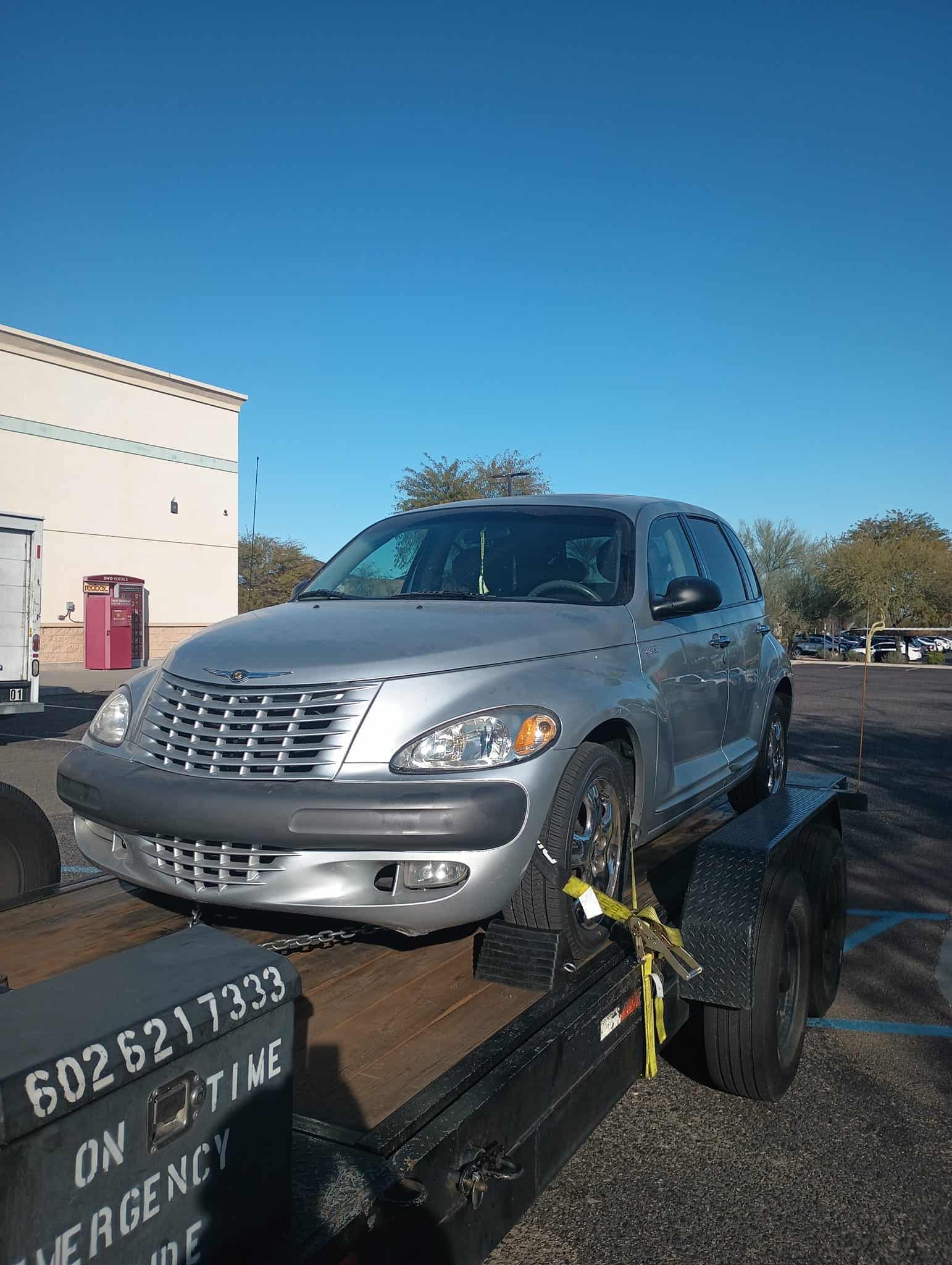
This is where DIY simply isn’t an option, and where having access to a roadside service that also offers towing makes all the difference. If the spare situation is a dead end, we can tow your vehicle to the nearest tire shop rather than leaving you stranded on the side of the road waiting for a solution that isn’t coming.
That one-call capability matters. You don’t want to be coordinating between a tire change service and a separate towing company while you’re sitting on a freeway shoulder in Glendale at 11 p.m. One provider who can assess the situation and handle whatever it requires — tire change, tow, or both — is the practical answer.
It’s also worth knowing that run-flat tires, while they allow you to drive about 50 miles after a puncture, are not a permanent fix and can be difficult to source for replacement. In Arizona’s summer heat, they degrade faster than in cooler climates. Our technicians can tell you on the spot whether what you have is safe to drive on or needs immediate attention.
The broader point is that not every flat tire situation resolves with a spare swap. Our roadside service accounts for that. DIY doesn’t.
How Much Does Roadside Assistance for a Flat Tire Cost — and Is It Worth It?
This is the question most people are quietly asking before they decide whether to call. And the honest answer is: less than you probably think.
On-demand roadside service calls for a flat tire typically run in the $60–$75 range nationally. Our service calls start at $65 — which is on the lower end of that range for the Phoenix metro area. There’s no membership required, no annual fee, and no waiting on hold with an insurance dispatcher who then has to find a third-party contractor. You call, we come.
Compare that to the alternative. If you attempt DIY and damage a TPMS sensor in the process, that sensor alone can cost $50–$150 to replace. If you over-torque the lug nuts and strip a wheel stud, that’s a more involved repair. And if the situation escalates — say the vehicle slips off the jack, or you’re stranded for hours because the spare turned out to be unusable — the cost in time and stress compounds quickly.
For customers who have roadside assistance through their insurance or a membership plan like AAA, that coverage may apply to a tire change if you have a usable spare. But those plans often come with wait times that can stretch to an hour or more — sometimes significantly longer. One of our customers specifically mentioned calling us after being told they’d wait four hours through their existing coverage. We had them back on the road in under 30 minutes.
For drivers in Glendale and across Maricopa County who want a straight answer on cost and a fast response, on-demand service at a transparent flat rate is often the most practical option — membership or not.
When to Call for Roadside Assistance vs. Changing the Tire Yourself
Here’s the short version: if you have a usable spare, you’re in a safe location, it’s not the middle of an Arizona summer afternoon, and you have the right tools — go ahead and change it yourself. That’s a reasonable call.
But if any part of that picture is missing — no spare, a freeway shoulder, extreme heat, nighttime, seized lug nuts, or a situation that just doesn’t feel safe — calling for professional roadside service is the smarter move. Not because you can’t handle it, but because the risk-to-reward math shifts fast when conditions aren’t ideal.
We’re On Time Emergency Roadside And Battery Service LLC, based in Glendale, AZ, and we cover all of Maricopa County — 24 hours a day, seven days a week. If you’re dealing with a flat and you’re not sure which direction to go, give us a call at 602-621-7333. We’ll tell you straight what makes sense for your situation.