Summary:
If you’ve ever walked out to a dead battery on a summer morning in Phoenix and thought, “but I just replaced that thing,” you’re not imagining it. Car batteries in Arizona don’t follow the national rulebook. The standard advice — expect three to five years — was written for climates that give batteries a break. Arizona doesn’t. The heat here is relentless, it compounds daily, and it does damage that most drivers never see coming until they’re stuck in a parking lot at noon in August. This page explains exactly what’s happening, why it happens faster here than almost anywhere else in the country, and what you can do about it.
Car Battery Lifespan in Arizona: What the Heat Actually Does
The national average for car battery lifespan is three to five years. In the Phoenix metro — Glendale, Tempe, Mesa, Chandler, all of it — the realistic number is closer to two to three years, and many local mechanics will tell you to plan for two if you’re parking outside every day. Heat accelerates the chemical reactions inside a battery. That sounds like a good thing — faster reactions mean more power — but it also means the battery’s internal components wear out faster, the fluid inside evaporates more quickly, and corrosion builds up at a rate that cooler climates simply don’t produce.
Phoenix averages around 100 days per year above 100°F. Under the hood of a parked car sitting in direct Arizona sun, temperatures can reach 140 to 180°F. Your battery is essentially baking every single day from April through October. That constant thermal stress is why we see so many battery failures in Glendale and across the valley that would be unthinkable in northern states.
Why Arizona Winters Don't Give Your Battery a Recovery Window
Here’s something most national battery guides miss entirely: in northern climates, the cold winter months actually slow down the same chemical degradation that summer heat accelerates. Batteries get damaged in summer, but the cold gives them a kind of pause. Drivers in Minnesota or Ohio might not realize how much heat damage accumulated over the summer because their battery limps through fall and winter before finally failing in spring.
In Phoenix, that recovery window doesn’t exist. Winters are mild — nighttime lows rarely drop far enough to slow anything down meaningfully. So a battery that spent June, July, and August baking under the hood just keeps degrading right through December and January. There’s no seasonal reset. The damage compounds continuously, year after year, until the battery simply can’t hold a charge anymore.
This is also why Arizona battery failures often feel sudden. The internal damage builds invisibly. A battery can still show a normal voltage reading at rest — 12.6 volts — and then fail completely the moment you ask it to actually start the engine. Monsoon season from July through September adds another layer. The humidity and fine dust that roll in accelerate corrosion on battery terminals. Even a well-maintained battery can develop enough buildup at the terminals to cause starting problems.
The practical takeaway for Phoenix metro drivers: if your battery is approaching the two-year mark and you haven’t had it tested recently, don’t wait for a warning. The odds of a sudden failure increase sharply after that point, especially heading into summer. A load test — not just a voltage check — will tell you what’s actually going on inside the battery before it leaves you stranded.
Signs of a Bad Battery vs. Alternator Problems
Slow cranking when you turn the key is the most common early signal. If the engine hesitates before it catches — especially on a hot afternoon after the car has been sitting in the sun — that’s your battery struggling under load. Dim headlights, a battery warning light on the dash, or a faint clicking sound instead of the engine turning over are all signs worth taking seriously.
What makes Arizona tricky is that the warning window is shorter than most drivers expect. In cooler climates, a weakening battery might give you weeks of slow cranking before it finally dies. In Phoenix heat, that window can compress to days. The battery is already operating at the edge of its capacity just handling the thermal stress, so when it starts to go, it often goes fast.
One thing worth knowing: if your car starts fine in the morning but struggles after sitting in a hot parking lot all afternoon, that’s a heat-specific pattern. The battery’s ability to deliver power drops as temperature climbs. A battery that’s borderline healthy will often pass the morning test and fail the afternoon one. If you’ve noticed that pattern — especially during summer — it’s a reliable sign that replacement is coming soon.
If your car starts but then dies shortly after, or if your headlights dim while you’re driving, the problem might not be the battery at all — it could be the alternator. A failing alternator won’t recharge the battery while the engine runs, so even a new battery will keep dying. Getting the right diagnosis before replacing anything saves you both money and frustration.
Car Battery Cost in Arizona: What You Should Expect to Pay
Battery replacement costs vary depending on the vehicle, the battery type, and who’s doing the work. For most standard vehicles, a quality replacement battery runs somewhere between $100 and $200 for the part itself. Add labor, and the typical all-in cost lands between $150 and $300. For vehicles that require premium AGM batteries — which includes many modern cars, especially European makes — the battery alone can run $200 to $325 or more.
Luxury and performance vehicles tend to sit at the higher end. A BMW, Mercedes, or Range Rover battery replacement often comes in between $400 and $500 when you factor in the battery, installation, and the required system registration. That’s not a markup — it’s the actual cost of doing the job correctly on a vehicle with a sophisticated battery management system.
New Car Battery Cost: What You're Actually Paying For
When someone quotes you a battery replacement price, there are a few things that go into that number beyond just the part. The battery itself is the biggest variable — a standard flooded lead-acid battery costs significantly less than an AGM battery, and the right choice depends on what your vehicle requires. Installing a standard battery in a car that was designed for AGM isn’t just a compromise; it can cause the charging system to behave incorrectly and shorten the new battery’s life.
Then there’s the labor. A straightforward battery swap on a simple vehicle takes 15 to 30 minutes. On vehicles where the battery is located under the seat, in the trunk, or requires a system reset after installation, the job takes longer and the cost reflects that. That reset — sometimes called battery registration — is the step where a technician uses a diagnostic tool to inform the car’s computer that a new battery has been installed. Without it, the charging system doesn’t calibrate correctly, and the new battery starts its life at a disadvantage.
For mobile service specifically, you’re also paying for the convenience of not needing a tow. If your battery dies at home, at work, or in a parking lot, a mobile technician who comes to you and handles everything on-site is almost always cheaper than the combination of a tow truck fee plus shop labor. We carry batteries built for Arizona’s heat conditions — not whatever happened to be on the shelf. For most Phoenix metro drivers, mobile replacement is the faster, more affordable, and frankly more practical option, especially in the middle of summer when you don’t want to be standing outside waiting for a tow.
This is one of the most common and most costly mistakes drivers make. The symptoms of a failing battery and a failing alternator can look almost identical from the driver’s seat, but the fixes are completely different. Replacing a battery when the alternator is the real problem means your new battery will be dead within days. Replacing an alternator when the battery is the issue means you spent several hundred dollars unnecessarily.
Here’s the practical breakdown. If your car won’t start at all — no cranking, just a click or silence — the battery is the most likely culprit. If the car starts but then stalls or dies while driving, the alternator is a stronger suspect, because a healthy alternator should be recharging the battery as the engine runs. Dimming headlights while the engine is running, flickering dashboard lights, or a battery warning light that comes on while you’re in motion all point toward the charging system — meaning the alternator — rather than the battery itself.
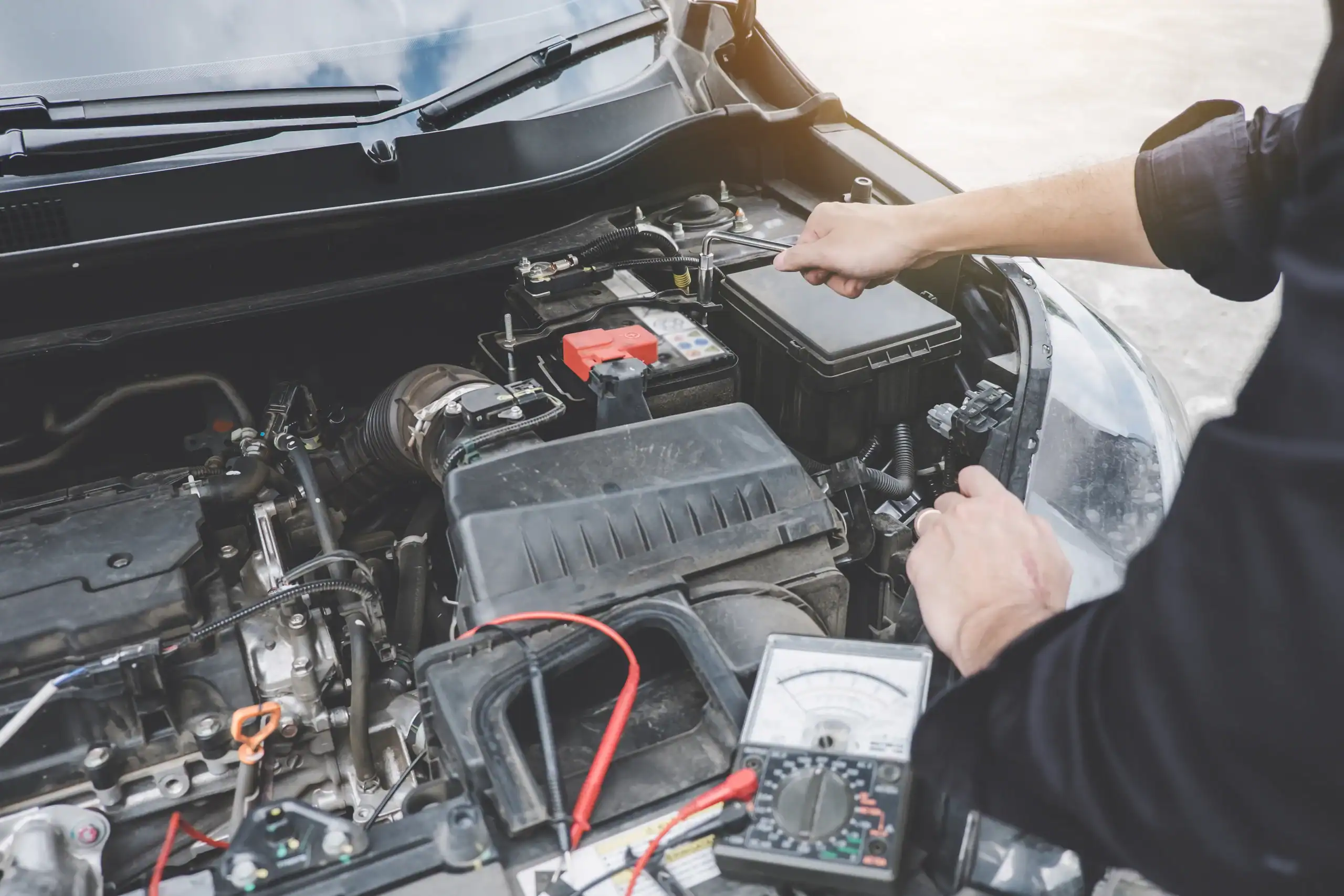
A proper load test will tell you definitively what’s going on. Voltage alone doesn’t give you the full picture. A battery can read 12.6 volts at rest and fail completely under the load of starting the engine. A load test simulates real-world demand and shows you exactly how much capacity the battery actually has left. Similarly, checking the alternator’s output while the engine is running reveals whether it’s producing the voltage needed to keep the battery charged.
We always diagnose before we replace. If you call us out for a dead battery and the alternator is actually the issue, we’ll tell you — because putting a new battery on a bad charging system just means you’ll be calling us again in three days. One visit, honest diagnosis, right fix.
Dead Battery in Phoenix? Here's What to Do Next
If there’s one thing to take away from all of this, it’s that Arizona changes the math on car battery lifespan in ways most people don’t account for until they’re already stranded. Two years is the realistic planning horizon for Phoenix metro drivers who park outside. The heat is relentless, the damage is invisible until it isn’t, and the failures tend to happen fast.
The good news is that it’s entirely preventable with a little awareness. Know how old your battery is. Get it load-tested before summer hits. And if you’re already past the two-year mark and haven’t had it checked, don’t wait for a 115-degree afternoon to find out it’s done.
If you do end up stranded — or you just want someone to come to you before that happens — we’re available 24 hours a day, seven days a week, across Glendale, Mesa, and everywhere in between throughout Maricopa County. We’ll come to you, test it, and replace it on the spot if needed. No tow, no waiting room, no surprises on the bill.