
Summary:
You are parked in a strip mall lot or sitting on the freeway shoulder, and something is plainly wrong with your vehicle. Maybe you are hearing a harsh rattle you have never heard before. Maybe a warning light popped on. Maybe the engine refuses to turn over altogether. Now you find yourself asking the question every motorist eventually faces: can I nurse this car home, or is it time to dial for a tow?
The answer is not always obvious. Here is a breakdown of 10 unmistakable warning signs that your car should stay parked, along with why desert driving across Maricopa County, AZ adds serious urgency to every single one of them.
When Your Car Is Telling You Not To Drive It
Most mechanical failures do not begin with loud explosions. They start quietly as a strange odor, a faint grinding noise, a steering wheel vibration, or a dashboard icon you keep meaning to have checked out. The challenge is that many drivers brush off those early warnings as background noise to deal with on the weekend. Sometimes you get away with it, but far more often, you do not.
Deciding between driving to a repair facility and calling a tow truck comes down to one core question: will continuing to roll make the underlying damage substantially worse? Frequently, the answer is a resounding yes. Pushing an overheating engine just five miles further can cause the block to seize entirely. Ignoring a mushy brake pedal on the freeway can spark an emergency far worse than a repair bill. Recognizing that boundary can save you thousands of dollars, along with a massive amount of frustration.
Warning Signs That Mean Stop The Car Now
The first category of symptoms calls for immediate action with zero second-guessing. If your coolant temperature needle begins climbing toward the red zone, pull over safely without delay. Continuing to run an overheating engine, even at a slow crawl, can warp cylinder heads, blow head gaskets, and ruin internal components that cost thousands to rebuild.
Across Phoenix and the wider Valley, this is far from a theoretical danger. When summer asphalt temperatures surge past 160°F, your vehicle’s cooling circuit is already operating under extreme strain. A sticky thermostat or a minor radiator leak that might be manageable in a mild climate can trigger complete engine destruction in the desert within minutes.
A flashing check engine light demands the same swift reaction. A steady light usually points to an emissions sensor or minor fault, but a flashing light signals that your engine is actively misfiring. Driving under misfire conditions dumps unburned fuel straight into the exhaust, destroying your catalytic converter in short order. Pull over, turn off the ignition, and get a professional on the line.
Thick smoke billowing from the engine bay, or an acrid burning odor you cannot pinpoint, falls squarely into this urgent category. Smoke confirms that fluids or wiring are actively overheating or burning, which is never a situation where you should keep rolling to see what happens. The same goes for rapid fluid loss. A minor oil drip can wait for a regular inspection, but fresh fluid pooling under the chassis or spraying along the undercarriage means you are losing critical oil pressure, radiator coolant, or hydraulic brake fluid, any of which can strand you or trigger a collision within miles.
Brake issues represent an immediate safety hazard rather than a standard mechanical repair. If your pedal feels soft, drops toward the floorboards, or makes a harsh metal-on-metal grinding sound during stops, keep the vehicle parked. Hydraulic brake failure rarely gives plenty of warning before pedal pressure disappears completely.
Signs That Are Easy To Dismiss But Shouldn't Be
Other warning signs are easier to brush aside because the vehicle still turns on and moves forward, making it seem fine on the surface. These ambiguous moments are precisely where motorists tend to make costly mistakes.
An engine that struggles to crank, or starts only on occasional tries, is a classic warning sign. If a coworker gave you a jump this morning and the car fired up, it feels tempting to assume the crisis is over. However, a battery that required external cables is already degraded. In Maricopa County, that reality carries serious weight.
Automotive batteries in the Valley average a lifespan of just two to three years, roughly half of what drivers enjoy in cooler states, because relentless heat rapidly accelerates internal electrolyte evaporation and plate corrosion. A battery that barely scrapes by in late spring will often collapse completely in midsummer. If your vehicle needed a boost to get going, have the charging system tested or replaced before depending on it for your daily commute.
Transmission troubles are equally common for drivers to downplay. When a gearbox hesitates before engaging, slips out of gear during acceleration, or shudders between shifts, internal components are crying out for attention. Continuing to commute on a struggling transmission risks stranding you in heavy traffic and can transform a manageable solenoid fix into a total transmission rebuild.
Loose, wandering steering or a violent pull to one side calls for the same caution. An alignment or suspension fault is not something to watch over the coming weeks; it needs resolution before you merge into 75 mph traffic along the I-10 corridor.
Finally, if your car was involved in a collision, even a low-speed fender bender, do not conclude it is roadworthy simply because the wheels still rotate. Subframe bending, buckled steering tie-rods, and cracked cooling reservoirs are frequently hidden beneath exterior plastic bumpers. A vehicle that looks reasonably intact can easily harbor alignment damage that makes highway speeds unsafe.
Why Arizona Heat Changes The Math On All Of This
Much of the conventional driving advice published online caters to moderate, four-season climates where minor automotive glitches develop gradually over months. In Maricopa County, those assumptions do not hold up.
Arizona logged an unprecedented 31 consecutive days with temperatures at or above 110°F in 2023. That sustained thermal pounding pushes every mechanical system in your car to its limit. Rubber belts crack, protective fluids thin out, cooling lines dry out, and electrical cells degrade rapidly. A minor mechanical problem that would simmer slowly up north can reach catastrophic failure in the desert in a tiny fraction of the time.
How Phoenix Heat Affects Your Car Battery Specifically
Dead batteries trigger more roadside assistance calls across the Phoenix metro than any other breakdown, and the explanation is straightforward: severe ambient heat stands as the primary culprit behind battery failure, as verified by AAA automotive studies. While freezing temperatures do reduce starting power, intense heat does the true permanent damage by cooking the internal plates and boiling away vital fluids.
Because of this constant exposure, Valley car batteries tend to die abruptly without warning. You might drive to work on a Tuesday morning without a single hesitation, only to return to a completely unresponsive vehicle on Wednesday afternoon. Nothing dramatic occurred; the battery simply reached the end of its chemical endurance after enduring months of triple-digit temperatures. There is rarely a sluggish warning crank; it simply gives out on the spot.
That sudden failure pattern is why our team provides mobile on-site battery testing and replacement throughout Maricopa County as a dedicated primary service. When your battery dies in a Glendale shopping lot or on the far side of Mesa, you do not need to pay for a costly flatbed tow to a dealership; you need a technician to bring the right battery to your parking space, handle the swap right there, and verify your starting system. We also complete warranty registration on every new battery we install at no extra charge, giving you documented coverage from day one. Many services skip that paperwork entirely, creating major headaches if you ever need warranty support down the road.
If your car battery is over two years old and has not been evaluated recently, do not wait for the peak of an Arizona summer to learn its condition. A rapid voltage and conductance test reveals if you have sufficient reserve capacity or if you are one scorching commute away from being stranded.
What To Do When You're Stranded In Maricopa County
If your vehicle begins acting up and you question its safety, prioritize your personal security first. Maneuver as far onto the right-hand shoulder as possible, bring the car to a full stop, and activate your four-way emergency flashers immediately. If you are stopped along an active freeway or a multi-lane parkway, stay seated inside with your seatbelt buckled; the vehicle cabin offers far greater protection than standing beside high-speed traffic. If you feel uneasy about your surroundings, keep your doors locked and contact dispatch right away.
Once you know the vehicle should not be driven, the next step is choosing a trustworthy service provider. Arizona law under ARS §28-1108 mandates that all tow truck operators register through the Department of Public Safety and maintain proper operating permits, though compliance varies across independent operators. Calling a Better Business Bureau accredited service with verified customer reviews and transparent rates is the most dependable way to avoid predatory fees during an emergency.
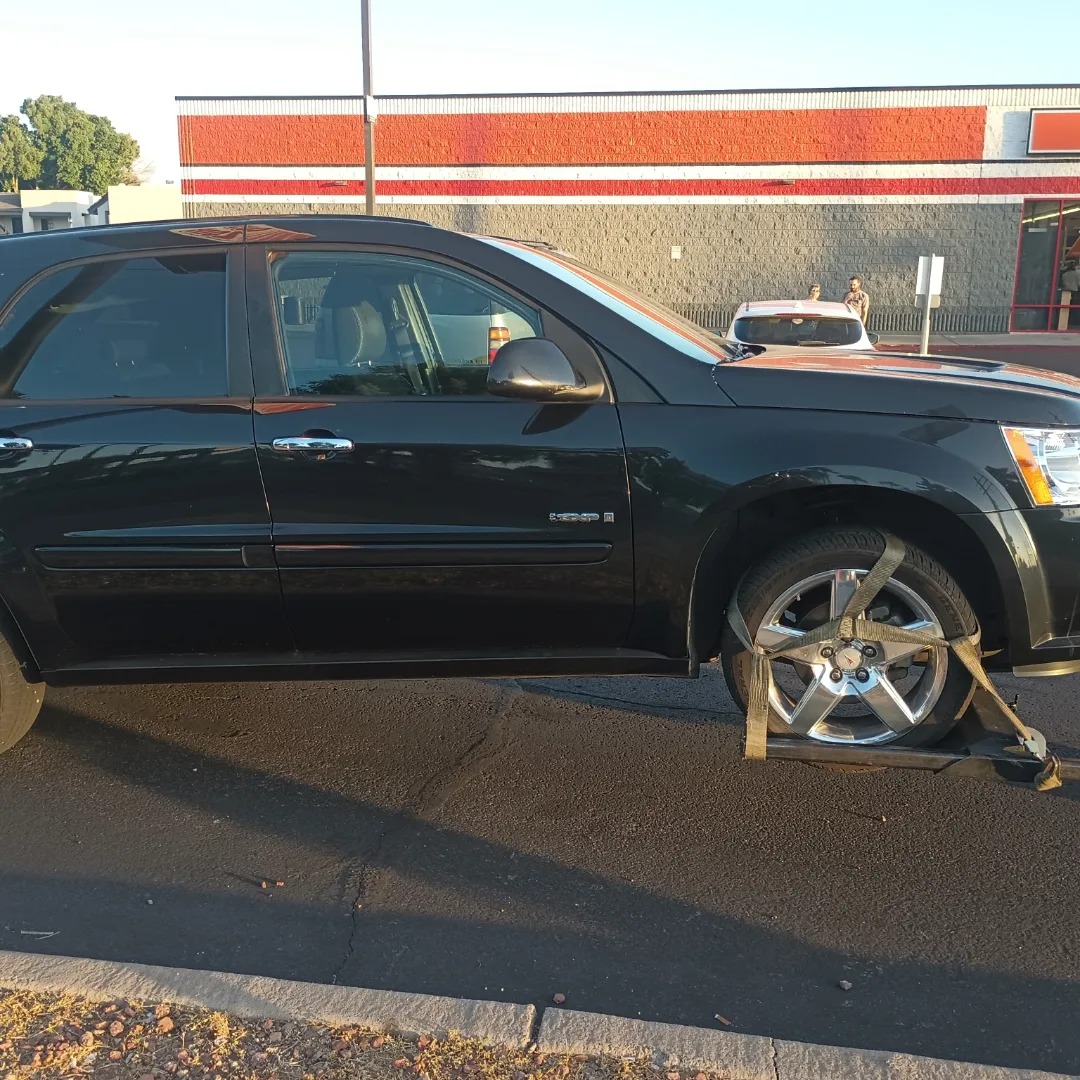
Our coverage spans all of Maricopa County, extending from Glendale across to East Mesa, up through the North Valley, and across the entire metro grid. We arrive promptly and deliver complete solutions: if your vehicle requires a tow, we haul it safely. If the trouble stems from a dead battery, locked-in keys, a puncture, or an empty tank, we resolve it right on the spot. You place a single call and your problem gets handled, sparing you the hassle of coordinating multiple companies while waiting roadside.
When In Doubt, Don't Drive It: Here's What To Do Instead
The clear lesson across every one of these 10 warning signs is simple: the predictable cost of a professional tow is far lower than the price of driving a compromised vehicle until it fails completely. A tow bill is an upfront, manageable expense, whereas an engine rebuild, a shredded transmission, or a high-speed brake failure on the highway is a life-altering emergency.
If your vehicle exhibits any of these symptoms, particularly during the peak of an Arizona summer, listen to what the car is telling you. Ease onto the shoulder, evaluate the situation calmly, and make the smart call before an easy repair turns into an overwhelming expense. Save our number in your phone right now so you can reach On Time Emergency Roadside And Battery Service LLC for dependable, around-the-clock help across Maricopa County whenever roadside trouble strikes.